
What Whitten wanted
Woodrow Whitten and the mass resignation of 1958

This is the second essay in my series investigating how George Pepperdine intended his college to relate to the church and how people have interpreted those intentions throughout the history of Pepperdine University.
In part one of this series, we saw that George Pepperdine articulated a principled vision of how his college should relate to the church. Twenty years later, the founder’s vision was challenged by a group of faculty members with a markedly different vision. The conflict between these two visions nearly destroyed the college, but rather than following blow by blow the dramatic events caused by this conflict, I’d like to focus on the disagreement itself. However, to make clear the nature of this disagreement, it’s helpful to get a sense of its historical context.
We’ve seen that from the founding in 1937, George Pepperdine intended his college to have a special relationship with the Churches of Christ. By 1956, that relationship had begun to fade. Pepperdine was still under the control of an all–Church of Christ board of trustees—indeed, the founder himself was still an active member of that board—and much of the college’s faculty belonged to the church as well.
But many on the faculty preferred a looser connection to the church than the founder intended. Both president Hugh M. Tiner and dean Earl V. Pullias tended to agree with the faculty in this respect, even though they were both members of the church. Around the country, the brethren began to doubt Pepperdine’s commitment to its church relationship. They accused the faculty of theological modernism and chose to send their children to more reliable church schools.
Around this time, the Board of Trustees removed Hugh Tiner from the presidency for personal indiscretion (a story for another time!), though the reason for his removal was not made public. The board selected M. Norvel Young to be the new president, beginning in the summer of 1957. Young was a preacher from Lubbock, Texas, where his Broadway Church of Christ was perhaps the largest congregation in the fellowship at that time.
Young was hired with the understanding that he would be able to choose his own dean to help him turn the college back toward the path that George Pepperdine had marked out for it at the founding. Earl Pullias, however, had no intention to vacate the deanship, which he had occupied for seventeen years. Only after months of resistance did the board force out Pullias so the incoming president could install J. P. Sanders, who had been dean at David Lipscomb College in Nashville.
Pullias’s ouster sparked a faculty revolt. As I read the evidence, this fight wasn’t really about the dean personally, but it did turn him into a symbol of the faculty’s struggle against the board over who would control the college’s direction. At its core, the conflict between the faculty and the board sprang from two differing visions of Pepperdine’s future. Put simply, the board wanted to draw the college closer to the Churches of Christ, while the faculty hoped the college would loosen—or even cut—its church ties. We have unusually good insight into this debate (relative to other events in the university’s history) thanks to surviving correspondence, essays, and reports written by some of the main figures, including one faculty champion, Woodrow Whitten.
Whitten was chairman of the social science department and president of the Pepperdine chapter of the American Association of University Professors (AAUP). He was part of the inner circle that led the college during the Tiner–Pullias years. Like most of the figures in this story, Whitten was a Church of Christ preacher, but he had been accused of theological modernism in brotherhood journals.1 In general, Whitten favored a more ecumenical outlook than the Board of Trustees or the new president, and this led him into conflict with the incoming administration.
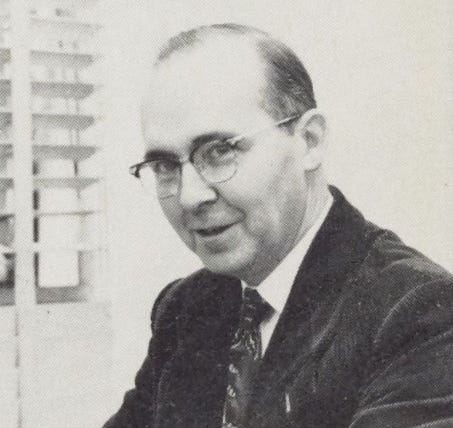
The way Whitten saw it, the Board of Trustees had come under the influence of denominational Church of Christ powers from Texas. He later wrote in his autobiography that the capture of the board by “the Texas Brethren” frightened many on the faculty.2 Whitten thought these unnamed Texans wanted Pepperdine to become more narrowly sectarian, to devote itself to the service of the Churches of Christ.
It’s not obvious to me who exactly Whitten understood these “Texas Brethren” to be. He may have meant the incoming president Norvel Young, who had spent the last 13 years in Lubbock, and perhaps also Reuel Lemmons, the editor of an influential brotherhood journal, Firm Foundation, headquartered in Austin. Lemmons himself wrote that he had been “rather closely associated with the inside workings of Pepperdine College” since about 1954.3
But it certainly wasn’t just Texans who wanted to draw Pepperdine College back into the fold. Young and Lemmons were part of a larger network of mainstream Church of Christ leaders worried about the college’s direction under Tiner and Pullias. The Churches of Christ don’t have any formal organization above the level of the local congregation, but in the 1950s there was a small set of journal editors (sometimes called “editor-bishops” by historians) who exercised some of the influence that in other communions belongs to denominational authorities. Back in the Church of Christ heartland of Middle Tennessee, leaders like B. C. Goodpasture (editor of the Gospel Advocate) and Batsell Barrett Baxter (professor at Lipscomb College and one of the most prominent preachers of his era) also supported a policy of strengthening Pepperdine’s ties to the church.4
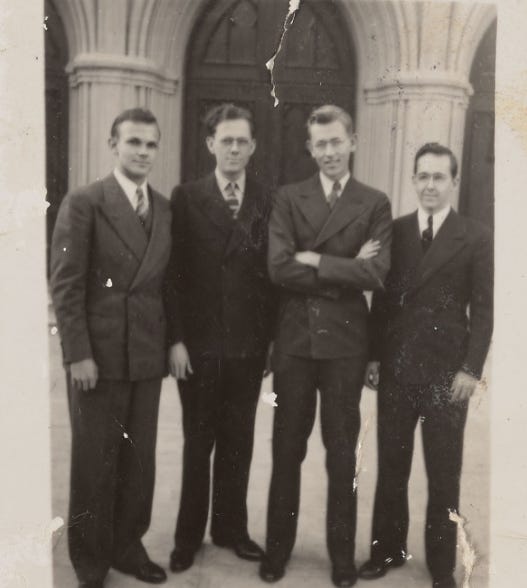
It seems to have been this policy that Whitten objected to most strongly. In his view, these mainstream figures represented the denominationalization of the Churches of Christ—not because they sought to establish literal presbyteries or bishoprics, but because he found their coordination stiflingly sectarian and perhaps also hypocritical. Whitten was concerned about the tension between “the ideal of universal non-sectarian, undenominational Christianity—‘church of Christ’ with a small ‘c’—and the actuality of denominational, sometimes sectarian, behaviour and characteristics (name, church polity, set of creedal doctrines and loyalties, etc.).”5
Whitten didn’t want Pepperdine to serve the mainstream churches—what he called “the ‘middle of the road’ segment of the ‘Church of Christ’”—which he viewed as too denominational. So it’s no surprise that he was opposed by such men as Baxter, Goodpasture, Lemmons, and Young, who essentially were themselves the mainstream, being four of the most influential figures in the fellowship at that time.
Instead, what Whitten wanted, and what he thought all “forward-looking Christian people” should want, was for Pepperdine to become a university not serving a single tradition (viz., the founder’s Churches of Christ), but seeking instead “the advancement of the church universal—the kingdom of God on earth.” In other words, he preferred “a non-sectarian, undenominational ideal of Christianity.”6
The reason Whitten belongs in this series on the founder’s intentions is that he didn’t just articulate his own alternate vision of the college’s ecumenical future. He framed his vision as one that fulfilled the goals set forth by George Pepperdine: “P. C. [i.e., Pepperdine College] according to its founder’s statement regularly printed in the college catalog has not now nor ever has had any organic connection with any church. It is governed by no church board; subscribes to no church’s creed; solicits funds from no church.”7 In Whitten’s reading of Mr. Pepperdine’s intentions, then, this lack of an “organic connection” explains why the college should pride itself “on being ‘undenominational’ in its Christian orientation.”8
Understood one way, Whitten was right about Mr. Pepperdine’s intentions: the college had never solicited donations from churches, and there was no denominational body that could name members to Pepperdine’s governing board, which was fully self-perpetuating. But Whitten overplayed his hand when he offered these facts as reasons to reject the conclusion that Pepperdine should relate differently to the Churches of Christ than to other communions. As a matter of rhetoric, Whitten’s attempt to establish himself as the best interpreter of the founder’s intentions was doomed to fail, given that Mr. Pepperdine himself was still very much alive and very much opposed to Whitten’s side of the debate.9
Perhaps surprisingly, Whitten and Mr. Pepperdine actually agreed about rather a lot. They both wanted the college to serve the universal church, rejecting denominationalism and sectarianism, and restoring the unity of the body of Christ. The core of the disagreement, as far as I can tell, was that Mr. Pepperdine believed that the Church of Christ as it existed in 1957 was the universal church, identical to the one established at Pentecost and described in the New Testament,10 whereas Whitten labeled such thinking “denominational and sectarian exclusiveness,” which was, he said, “already anachronistic […] in our ‘atomic age’.”11
Whitten and others on the faculty feared that the incoming administration, by “denominationalizing” the college in this way, would “undermine the academic standing and accreditation of the institution and produce strong resistance and near chaos both on the part of the faculty, student body and alumni.”12 He urged the administration to cut ties with the Churches of Christ and dedicate the institution to the wider church, arguing that this was the most reliable way to turn the small college into a university with a solid academic foundation.
When it became clear that the new administration would not take his advice, Whitten encouraged the faculty to resign en masse in protest. Many heeded this call, and a significant portion of the faculty announced their resignations in February 1958.13 Historian David Baird has suggested that the dissidents may have delayed their resignations to inflict maximum disruption, as the college faced reaccreditation the next year, forcing the new administration to rebuild the faculty in the short interval.14
If those who resigned in protest indeed aimed to cripple the college, they failed. The new administration, under the leadership of Norvel Young, seized the opportunity to hire an even stronger faculty, won reaccreditation the next year, and ultimately turned Pepperdine into a university with a national reputation for the strength of its academics, all without abandoning the institution’s ties to the Churches of Christ.15
From the perspective of Whitten and his cohorts, weakening Pepperdine’s church ties must have looked like a good bet. Many of the great American universities of that era had been founded by a religious group, had gradually widened and weakened their affiliation, and eventually secularized, winning a tremendous academic reputation. That had been the recipe for the Harvards, Dukes, and Stanfords of the world. But this formula doesn’t seem to have worked the same way for institutions that secularized after World War II.16 Schools like Pepperdine have proven that cutting church ties is no requirement for improving academic quality.
The ouster of dean Pullias and the mass resignation that followed have attracted the attention of historians about as much as any other controversy in the history of Pepperdine.17 The fight made Pullias into a symbol of the interdenominational Pepperdine.18 The fourth president, William S. Banowsky, strongly identified his presidency with “the larger Christian vision which Earl Pullias had built into the soul of the school, but which had been systematically resisted by his opponents.”19 And Banowsky often sounded like Whitten: “Assiduously avoiding any official, organic, or legal ties, he [i.e., George Pepperdine] sought a strictly fraternal relationship between college and church.”20
But Banowsky hasn’t been the only one to adopt Whitten’s “organic” rhetoric, which has entered the institutional bloodstream. In his inaugural address, Pepperdine’s seventh president Andrew Benton echoed it again: “the University is not controlled by a church and has no organic link with any external organization.”21
In the rest of this series, we’ll address more fully these later developments in the reception of George Pepperdine’s thought. For now, it’s enough to say that, although Whitten left Pepperdine in 1958, his interpretation of the founder’s intentions has proven somewhat stickier.
See, e.g. Roy E. Cogdill, “Some Teachers at George Pepperdine College Reveal Their Attitude,” Bible Banner 10.3, Mar. 1948: 13–14. Whitten himself later wrote of this period, “I was becoming somewhat more liberal religiously, even though I preached for a very conservative and fundamentalist congregation of the Church of Christ.” See Woodrow C. Whitten, Out of the South: An Autobiography, n.p. (1979): 44.
Whitten, Out of the South, supra note 1.
Reuel Lemmons to J. P. Sanders, 22 May 1957, box 1, folder 1, David Baird papers, Pepperdine Univ. Special Collections and University Archives (SCUA).
See, e.g., Batsell Barrett Baxter to Norvel and Helen Young, 1 July 1957, box 1, folder 2, W. David Baird papers, SCUA; see also, “Pepperdine College,” Gospel Advocate 99.34, 22 Aug. 1957: 530.
[Woodrow Whitten], “Quo Vadis, Pepperdine College?,” [June 1957], box 1, folder 2, Baird papers, SCUA. The essay borrows for its title the Latin phrase quo vadis (“Where are you off to, pray tell?”), invoking questions about the school’s purpose and direction. This document is not signed by Whitten, but there is a pencil annotation that says, “W.W. June 1957.” I follow David Baird in taking this to mean that Whitten is the document’s author. Its language certainly matches that of other documents signed by Whitten. See W. David Baird, Quest for Distinction: Pepperdine University in the 20th Century, Pepp. Univ. Press (2016): p. 598 n. 52.
[Whitten], “Quo Vadis,” supra note 5.
[Whitten], “Quo Vadis,” supra note 5. David Baird suggests that Whitten misread this passage, understanding “church” to refer to a whole communion rather than an individual congregation, which is how George Pepperdine intended it. See Baird, Quest, supra note 5: p. 601 n. 39.
[Whitten], “Quo Vadis,” supra note 5.
This point was already evident to contemporaries of this debate, including one anonymous author (perhaps Norvel Young), who wrote to the chair of the Board of Trustees: “It is especially fortunate at this time that the Founder of the college and his wife are still living and on the board, for it is obvious that these opponents of any change are interpreting the Founder’s statement to mean that the college, since it is not organically connected with any church (which of course is true of all the other Christian colleges of which we know), must not serve the Church of Christ in a special or peculiar manner or in a way that it does not serve various denominations whose students come for training. On the contrary it should be plain to any student of the college that the fact that the board of trustess [sic] were to be selected from faithful members of a Church of Christ and that it is the plan of the board to select as many faculty from that church as is possible, considering the academic requirements, that the Founder intended for the college to serve the Church of Christ in a special way, even though not organically connected with it.” See “Suggestions for Don Miller’s consideration,” 20 June 1957, box 1, folder 2, Baird papers, SCUA.
Mr. Pepperdine makes clear his belief in this identity in his tract More than Life, where he writes: “In nearly every city in our land, especially in Southern and Western states, there is a body of disciples, some places small, other places large, which wear only the Scriptural name, church of Christ. This body is not one of the denominations and it does not affiliate with them […] The true church of Christ today is the same in name, faith, worship, and doctrine as in the days of the Apostles.” George Pepperdine, More than Life, Vermont Ave. Church of Christ (1949), George Pepperdine family papers, SCUA: 39, 40.
[Whitten], “Quo Vadis,” supra note 5. I have cleaned up the poor typing in this quotation. The original renders atomic as atonic.
[Whitten], “Quo Vadis,” supra note 5. Cf. Wade Ruby, Woodrow Whitten, et al. to Gentlemen, 2 May 1957, reproduced in the minutes of the Board of Trustees, vol. 3, SCUA: 236B ff.
Every source that reports the number of resignations gives a different total. In his autobiography, Whitten says 16. See Out of the South, supra note 2: 44. Historian David Baird identified 23 by name. See Baird, Quest, supra note 5: p. 601 n. 44. Historian Richard Hughes suggests the number of resignations was 27. See Hughes, “Faith and Learning at Pepperdine University,” Scholarship, Pepperdine University, and the Legacy of the Churches of Christ, 2004. In an interview, Norvel Young recalled the number of resignations as 28. See Young, interview by Jerry Rushford and Bill Henegar, 28 Feb. 1995, Oral History Interviews, SCUA. Donald V. Miller, who was chair of the board of trustees during the period in question, estimated that one-third of the faculty resigned. See Miller, “Three Crises of George Pepperdine College that Threatened Its Survival,” 6 Nov. 1998, box 3, James L. Lovell papers, SCUA. The student newspaper reported 11 resignations in a single week. See “Resignations Submitted by 11 on Faculty,” The Graphic, 14 Feb. 1958: 3.
Baird, Quest, supra note 5: 110. I find Baird’s suggestion plausible, as Whitten himself had served as a member of Western College Association accrediting teams for at least two Christian colleges and was very much attuned to the expectations and methods of such bodies. See Woodrow Whitten to Norvel Young, 3 May 1957, box 1, folder 1, Baird papers, SCUA.
To his credit, Whitten gladly reports this development in his 1979 biography: “I’m happy to say that even though the institution was transformed somewhat in character, Pepperdine is now Pepperdine University, and is prospering with a campus in Malibu as well as in Los Angeles.” Out of the South, supra note 2: 44.
There are plausible candidates here, schools that secularized mid-century and have since gained academic prestige, including Wake Forest and Boston University. But many schools that retained their faith heritage have gained similar reputations and many more that secularized have seen no corresponding academic improvement.
Donald V. Miller, who was the chair of the Board of Trustees during these events, later wrote a brief record titled “Three Crises of George Pepperdine College that Threatened Its Survival,” supra note 13. Howard A. White, the history professor who was hired in 1958 to replace Whitten as chair of the social science department, later wrote a fifty-plus page history of the events, based on archival sources. See White, “Crisis at Pepperdine College: A Decisive Change in Administration 1957–1958,” box 63, “Introduction to Restricted Files” folder, Howard A. White papers (HAWP), SCUA. David Baird devotes significant space to covering these events in his book Quest for Distinction, supra note 5.
I wrote about this in my essay The Legacy of E. V. Pullias, noting that Pullias later changed his mind about how the college should relate to the church, calling for “a very close, even intimate, relationship with what most would consider a confining sectarian group.” See White, “Crisis,” supra note 16: 53.
Quoted in Hughes, “Faith and Learning,” supra note 13: 27.
William S. Banowsky, “The Spiritual Mission of Pepperdine University,” 1 Apr. 1976, box 64, “Personal Politics of Presidency, Mar. 1976” file, HAWP, SCUA.
Andrew K. Benton, “Promises to Keep: Reaching Deep, Reaching Far,” 23 Sept. 2000, Box 1, “Benton” file, Pepp. Univ. Speeches collection, SCUA.