
A steady stream
Was George Pepperdine too worldly for the Churches of Christ?

The following essay was published last week as a letter to the editor of the Pepperdine Beacon, a student-led publication. With their permission, I’m republishing it here.
I recently read and enjoyed “We’re Number 1,” a two-part series in the Pepperdine Beacon by Dr. Michael Gose, professor of great books at Seaver College. In the series, Dr. Gose argues that Pepperdine University is the result of a marriage of ideas. He articulates these ideas in different ways throughout the first essay in the series, saying at one point that Pepperdine “wanted firm footing in both the secular and spiritual worlds” and later that “being industrious, spiritual, and American were part and parcel of the same thing.”
Dr. Gose traces this “apparent contradiction” to the biography of the founder George Pepperdine, whose entrepreneurial spirit may seem to have been at odds with a Church of Christ tradition that taught Christians to be “in the world, but not of the world.” Mr. Pepperdine’s marriage of the worldly and the spiritual reminds Dr. Gose of what he calls “the spirit of 1776,” a blend of Puritan spiritual fervor, American patriotism, and industriousness.
Dr. Gose’s account has much to recommend it. As an institution, Pepperdine owes much of its success to its longstanding commitment to a set of ideas inherited from its founder, ideas that were not universally accepted within the church. However, as a matter of intellectual history, these ideas are not nearly as alien to the Church of Christ context as Dr. Gose suggests. In fact, they recall the terms of a debate between two leaders of the Restoration Movement.
In Dr. Gose’s account, the Churches of Christ “existed in a southern and agrarian milieu,” teaching Christians to be “in the world, but not of the world.” He says that George Pepperdine, who was not born into the church, brought a different, more enterprising spirit to the church. The history of Mr. Pepperdine’s interactions with members of the church “has not been without notable conflict.”
In my view, however, Mr. Pepperdine fits comfortably within an intellectual lineage of different emphasis but equal antiquity within the church. The important thing to realize is that the Churches of Christ are flat rather than hierarchical: they have no popes, no synod or conference of bishops, no denominational bodies at all above the level of the local congregation. As a result, they have no mechanism for propagating anything like an official catechism, no way to establish an official churchwide position on any particular question. The church is just individual Christians attending individual congregations.
The lack of a hierarchical denominational structure doesn’t rule out family resemblances with respect to beliefs and practices. Indeed, there are many ways in which individual Christians and individual congregations belonging to the Churches of Christ resemble each other. But there is also, of course, constant contestation of differing viewpoints within the church. As a result, there have come to be different lines of thought within the church, traditions of teaching that are passed down through the generations, sometimes gaining prominence and sometimes retreating as they win and lose favor. I like to think of these traditions as streams.
For instance, it is certainly true that there is a stream of Church of Christ teaching that emphasizes an apocalyptic (i.e., world-renouncing) worldview, according to which Christians should be “in the world, but not of the world,” as Dr. Gose says. This separatist instinct has its roots in the teaching of Barton W. Stone, one of the most influential figures in the early days of the Restoration Movement (sometimes called the Stone–Campbell Movement). This stream taught that Christians are citizens of the Kingdom of God rather than any worldly state. They might sing, “This world is not my home; I’m just a-passing through.” At times, this stream even discouraged civic participation such as voting and military service.
But the apocalyptic stream is not the entirety of the Churches of Christ. There is another stream, alike in dignity, that is more optimistic about Christian involvement in worldly institutions. This second stream traces its roots to Alexander Campbell, the other figure lending his name to the Stone–Campbell Movement. Campbell was a reformist who taught that Christians had an important role to play in bringing about moral progress. This stream built lasting institutions like Campbell’s Bethany College in what’s now West Virginia, and it even produced politicians, including James A. Garfield, the 20th president of the United States.
For many decades, the Churches of Christ suffered infighting about the proper relationship between the church and external institutions like missionary societies, colleges, and orphanages. When George Pepperdine began attending services as a young boy in rural southeast Kansas following the conversion of his parents John and Mary Pepperdine, the churches in the area were strongly anti-institutional. As late as 1929, George remained staunchly opposed to church schools, writing “neither do we approve of the so-called ‘Bible Colleges’ established or operated by the Church.”1 Only through the intervention of friends like Hugh Tiner was he ultimately persuaded to devote his fortune to the cause of Christian education.
But it would be wrong to suggest that this institutional stream was foreign to the Churches of Christ. Indeed, by 1937 when George Pepperdine College opened, there was already almost a hundred-year history of higher educational institutions established and operated by members of the Churches of Christ. Hugh Tiner, who was so instrumental in making the college a reality, was himself a graduate of Abilene Christian College, another Church of Christ school. He would go on to be the first dean and second president of Pepperdine. Tiner was an institutionalist, taking on leadership roles in organizations such as the Rotary Club and UNESCO.
By the time Dr. Gose moved to California in 1958, Pepperdine had entered a new chapter of its history under the leadership of the college’s third president, M. Norvel Young. Young was an institutionalist par excellence who had been involved in establishing an orphanage and a college during his time as a Church of Christ preacher in Lubbock, Texas. Under his presidency, Pepperdine implemented a new playbook, marketing itself to potential donors as a politically and economically conservative institution. During this period, Pepperdine held an annual Freedom Forum celebrating free enterprise, all in an attempt to convince donors that the college was patriotic, anti-communist, and Christian.
But Pepperdine wasn’t the first school to adopt this playbook—in fact, it wasn’t even the first Church of Christ college to hold a Freedom Forum in the 1950s. Norvel Young was specifically inspired by the success of George S. Benson, president of Harding College, a sister school in Searcy, Arkansas. At Harding, Benson established the National Education Program, which promoted Americanism in a way that prefigured the success of Pepperdine’s similar programming. Benson is an important character in the story of how Pepperdine developed the ethos that reminds Dr. Gose so much of the spirit of 1776. It was Benson, formerly a Church of Christ missionary in China, who wrote a significant portion of Mr. Pepperdine’s essay “The Miracle of the American Way of Life,” from which Dr. Gose quotes to show that Pepperdine’s thought was in tension with Church of Christ teaching.
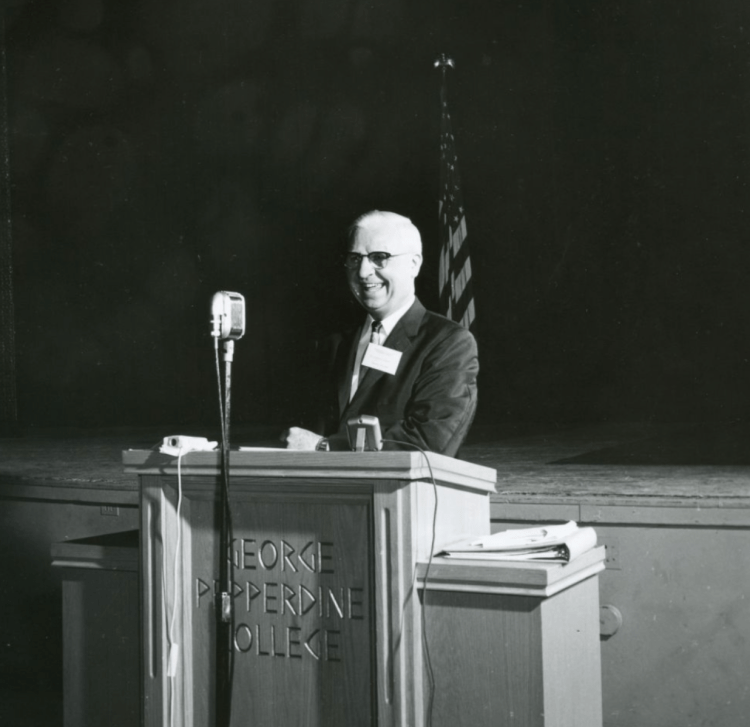
In light of major Church of Christ figures like Tiner, Young, and Benson, it’s clear that George Pepperdine was not unique in blending spiritual fervor with both industriousness and an interest in worldly institutions. In fact, he belonged to a stream of thought that can be traced back to the origins of the Restoration Movement. His enterprise was a reflection of one part of a varied tradition, rather than a departure from univocal church teaching. If Pepperdine University owes some of its success to this marriage of ideas, then its debt is due at least in part to a church that offers a range of approaches for engaging faithfully with the world.
W. P. Reedy and Geo. Pepperdine, “A Correction,” Apostolic Review, 16 Apr. 1929: 14.