
My erring brother
On George Pepperdine's failed attempt to heal a divided church

On my most recent trip to the university archives, I found a fascinating document among George Pepperdine’s papers. It’s a typed copy of a series of letters between Mr. Pepperdine and one W. R. Walker, a preacher among the independent Christian Churches. In their yearlong correspondence, the two men debated at significant length one of the issues dividing their two faith traditions: instrumental music in worship. The letters give us a glimpse of how Mr. Pepperdine thought about Biblical interpretation, Christian worship, and division in the church.
In 1953, George Pepperdine was having a hard time. He had once earned a great fortune as the founder and president of the Western Auto Supply Company, which he used to support his philanthropic foundation as well as a liberal arts college in Los Angeles. But by 1951, the George Pepperdine Foundation, under its founder’s leadership, had so squandered its endowment in imprudent investments that it needed to be dissolved to pay its many creditors.
Mr. Pepperdine’s personal fortune had been used as collateral to secure loans propping up the foundation, so the foundation’s financial problems quickly became his own problems. Over the next few years, he endured one lawsuit after another, brought by creditors hoping to regain what was owed them.
The dissolution of the foundation threatened the existence of George Pepperdine College, which survived the legal proceedings. Without the prospect of further gifts from the founder, however, the college had no way to cover its operational expenses except to rob its own endowment, which shrank year after year. In 1953, Mr. Pepperdine was still the chair of the college’s board of trustees, but he had been forced to sell his family’s mansion on fashionable West Adams Boulevard and move into a more modest home. He put the proceeds of the sale toward satisfying his creditors.
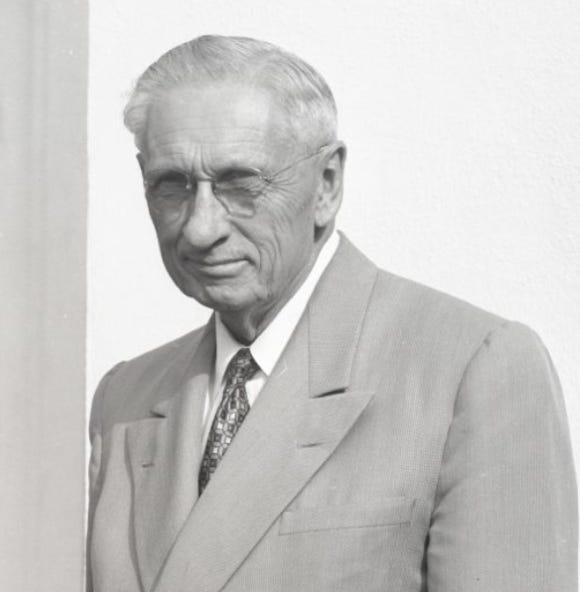
Perhaps it was as a distraction from these troubles that Mr. Pepperdine struck up a correspondence with W. R. Walker, a preacher from Columbus, Ohio. As the president of Standard Publishing, which printed the flagship journal Christian Standard, Walker was one of the most prominent and best-connected leaders in the independent Christian Churches.
The Christian Churches are the closest cousins of Mr. Pepperdine’s Churches of Christ, as they both sprang from the Stone–Campbell Restoration Movement. The process by which the united movement split in two was gradual, but it’s typically dated to 1906, when the U.S. census recognized them as two churches for the first time. The reason for the division was complicated, but the most visible (and most commonly cited) difference is that the Christian Churches worship with instruments while the Churches of Christ worship a cappella.
Both men had lived through this division. George Pepperdine found it “tragic” and initiated the correspondence with Walker in the hopes that “we might find some basis for cooperation and harmony among the people of God.”1 Walker’s response shows that he too was hopeful that the two sides could be reconciled: “To my way of thinking, we are brethren. I wish we could act as such.”2 Walker, however, also knew that past attempts to restore unity had failed, including the Witty–Murch talks in the late 1930s and 1940s. Walker’s hope was tempered with fear that further discussion would be fruitless.
Thus began a yearlong correspondence between the two men about the role of musical instruments in the church’s worship. Over 15,000 words were exchanged across at least a dozen letters.3 Mr. Pepperdine hoped that, by persuading Walker, he could win over the whole Christian Church to his position and restore the unity of the church: “The most valuable service of my life-time, or of yours, for the Lord’s Cause and the salvation of mankind, would be to have some effective part in bringing our estranged brethren together, not in compromise of principles, but in full obedience of and respect for the Word of God.”4
For the most part, the two men remained respectful, despite their disagreement. Throughout his letters, Mr. Pepperdine constantly repeats, “I wish to give due credit to your long experience and mature judgment, and I want to show proper respect for your evident sincerity.”5 Walker tends to be more restrained: “I appreciated the fine spirit of your letter, Brother Pepperdine.”6 At times, Walker’s tone is a bit more strained as he struggles to reconcile the strength of his conviction with Christian humility. He writes to Mr. Pepperdine, “One or the other of us has spiritual astigmatism,” and he closes one letter with “Perhaps we all should search our hearts anew.”7
Mr. Pepperdine’s letters often grow quite heated, adopting extreme rhetoric to communicate the strength of his feelings. In one letter, he calls the Christian Churches’ insistence on using instruments in worship “a great monster, dividing the churches asunder; a horrible cancer, destroying the life of a great portion of the body of Christ; a dreadful demon which explodes the progress of the church.”8 Mr. Pepperdine took to addressing Walker as “my erring brother,” citing the second epistle to the Thessalonians as justification for admonishing him as a brother.9
But as interesting as the rhetoric in the letters is, what makes them so interesting is their argumentation. Coming as they do from very similar church backgrounds, Walker and Mr. Pepperdine share many assumptions. They both rely on the New Testament for instructions regarding church practice. They both recognize that the New Testament commands singing. And they both believe that the New Testament is silent as to the place of musical instruments in the church’s worship.
The central question that divides these two men is how to interpret the New Testament’s silence.
You might think that the heart of their disagreement is a classic showdown between the regulative principle of worship (whatever is not expressly commanded is forbidden) and the normative principle of worship (whatever is not expressly prohibited is permitted). But neither Walker nor Mr. Pepperdine expects such principles to have universal application.
Faced with Biblical silence, they both turn to analogical reasoning. The New Testament does not say whether instruments are permitted in the church’s worship, but it does have commands about other parts of worship. Can we gain any clarity on instruments by comparing them to cases that seem more clear cut, using what is plain to interpret what is difficult?
In the letters, both men grant that there are at least two categories of worship practices about which the New Testament is silent. First, they agree on the permissibility of aids to worship (hymnals, microphones, tuning forks, etc.). Such practices are not authorized in the New Testament, but they are permissible to the extent they aid in commanded acts of worship such as singing. Second, they also seem to agree that acts of worship not mentioned in the New Testament are forbidden (animal sacrifices, unauthorized additions to the Lord’s Supper, etc.). Such acts are known to have featured in Jewish worship at the Temple but are not authorized in the New Testament and are thus held to be forbidden for the church.10
The heart of the disagreement is whether the use of musical instruments in worship is an aid to worship (like the hymnal) or an act of worship (like animal sacrifice). Walker argues repeatedly that the instrument is an aid to worship and that, if Mr. Pepperdine has no objection to the hymnal, about which the New Testament is silent, then he should have no objection to the organ either.11 Mr. Pepperdine responds that hymnals don’t divide churches because people who don’t want to use them can look elsewhere, but that there’s no way to avoid the sound of musical instruments. Hymnals, he says, do not introduce “an additional kind of music” the way that musical instruments do.12
Mr. Pepperdine argues that instrumental music is an act of worship and that, if Walker would object to animal sacrifice in the church’s worship because it is unauthorized in the New Testament, then he should object to musical instruments for the same reason.13 Likewise, he says that Walker would object to the addition of candy or milk to the Lord’s Supper because they are unauthorized in the New Testament and that musical instruments are likewise an unauthorized addition.14 Walker responds that the use of musical instruments is not an act of worship because worship occurs in the heart—it is a spiritual act, not an outward one.15
Despite repeated attempts, they were unable to come to an agreement as to whether musical instruments are permissible aids to worship like hymnals or forbidden acts of worship like animal sacrifices.16 Both sides produced similar analogical arguments, establishing a category about which they agreed and then trying to argue that musical instruments belong in that category.
Given that so much of their disagreement was about how to interpret the New Testament’s silence, we might also consider where the correspondents are themselves silent. Walker makes much of Christian liberty, arguing in a Pauline mode that, where Christians have differing opinions on matters not discussed in the Bible, they must not refuse each other fellowship: “The general attitude of New Testament writers relating to Christian liberty rebukes those who insist on dictating to their brethren in areas where honest differences might exist.”17
But Walker maintains strict silence about Paul’s unambiguous teaching that, in matters where a “weaker brother” has a troubled conscience on a matter of Christian liberty, the strong must not cause the weak to stumble.18 Walker’s silence suggests he knew that Pauline teaching on this subject cuts against his position. If musical instruments are, as he insists, a matter of opinion, Paul would have him silence the organ to avoid troubling the conscience of anyone in his church who objects to it.
Mr. Pepperdine doesn’t mention the “weaker brother” teaching either, though, probably because to do so would be tantamount to admitting that musical instruments are a matter of opinion and that he is the weaker brother whose conscience is troubled by a question of Christian liberty.
Another surprising silence in this correspondence is Walker’s failure to quote from Psalm 150, which commands worship with specific musical instruments: “Praise him with the sounding of the trumpet, / praise him with the harp and lyre.” Walker does mention in a general way that “many of the Psalms counsel the use of instruments,”19 but to quote one might suggest that the use of instruments is an act of worship rather than an aid to worship, which would undermine his central argument. Instead, it’s Mr. Pepperdine who quotes a command to use instruments from the Book of Chronicles in order to show that the use of musical instruments in the Temple cultus was closely connected to animal sacrifice.20
In the end, the correspondence petered out. Walker repeatedly gestured toward “the futility of further correspondence,” suggesting that “further correspondence on the subject will be fruitless.”21 Mr. Pepperdine insisted on having the final word, meticulously responding to each of Walker’s arguments in lists of points and counterpoints. It seems that Walker ultimately stopped responding—the document ends with Mr. Pepperdine’s fervent prayer from the last letter:
Please God! Please help our erring brother to see the tragedy of his way and give him enough faith, conviction and honor to change his course and spend the rest of his days in trying to restore the glory of the church and help to save it from the ravages of this divisive, unholy and destructive demon and practice which is the most effective tool of Satan. Amen.22
For Mr. Pepperdine, this last (apparently unanswered) letter meant that his dream of reuniting the churches and thereby rendering “the most valuable service of my life-time” went unrealized. He devoted himself, in the remaining years of his life, to doing what he could to leave the college on a firm footing, though his straitened circumstances prevented him from contributing financially. The college became his chief legacy to later generations.
The Pepperdine–Walker correspondence shows two men troubled by the divide between their churches but unable to reconcile their differences. Both men had inherited a divided movement, and neither had the resources to restore unity. They were like two powers engaged in a cold war, each dug in and unwilling to de-escalate, locked in a stalemate. Despite their similar backgrounds and shared commitments, they failed to persuade each other with their analogies. Their churches remain divided to this day.
Epilogue
In 1957, a few years after the conclusion of the correspondence, Walker officiated at the funeral of his longtime friend P. H. Welshimer, another minister in the Christian Church. At the funeral, Walker would have been reunited with Welshimer’s daughter Mildred, who had nursed her father in his last days.23 Over a decade later, when both Walker and Mr. Pepperdine had died, Mildred Welshimer Phillips (who by then had taken a married name) would make a large donation to what was by then Pepperdine University, funding the construction of the Phillips Theme Tower. The cross tower, still standing on Pepperdine’s Malibu campus, is an enduring symbol of fellow feeling between two estranged churches.
George Pepperdine to W. R. Walker, 20 May 1953, box 7, folder 16 (“Correspondence”), George Pepperdine Family papers (GPFP), Pepperdine University Special Collections and University Archives (SCUA).
W. R. Walker to George Pepperdine, 27 May 1953, ibid.
Eleven letters are copied in the archived typescript, but the first two letters both mention an earlier one from Mr. Pepperdine that has apparently not survived.
George Pepperdine to W. R. Walker, 22 Aug. 1953, box 7, folder 16 (“Correspondence”), GPFP, SCUA.
George Pepperdine to W. R. Walker, 22 Aug. 1953, ibid.
W. R. Walker to George Pepperdine, 27 May 1953, ibid.
W. R. Walker to George Pepperdine, 3 Apr. 1954, ibid.
George Pepperdine to W. R. Walker, 22 Aug. 1953, ibid.
See George Pepperdine to W. R. Walker, 22 Aug. and 6 Oct. 1953, ibid. The passage cited is 2 Thess. 3:15.
Walker never explicitly affirms this principle, but the shape of his arguments suggests that at the very least he doesn’t intend to contest it. He insists that the use of musical instruments does not constitute an act of worship, perhaps because he thinks unauthorized acts of worship are forbidden. He does argue that musical instruments in worship cannot be inherently sinful because their use was commanded under the Mosaic dispensation, but he never disputes Mr. Pepperdine’s statements about the status of animal sacrifices in the church’s worship.
“Instrumental music is not an act of worship – it is an aid in harmonizing in vocalization. That it is such an aid cannot be denied.” W. R. Walker to George Pepperdine, 3 Apr. 1954, box 7, folder 16 (“Correspondence”), GPFP, SCUA.
“The hymn-book does not add an additional kind of music to the worship; it is truly an expedient, a help in performing the command to sing and it makes no noise itself.” George Pepperdine to W. R. Walker, 22 Aug. 1953, ibid. Cf. “…the hymn-books, tuning forks, etc., make no mixture of sounds, or any sound that can be heard by the congregation while singing. They are truly aids, while instrumental music is more than an aid. It is an additional kind of music. It produces a mixture which the hearers cannot unscramble in order to hear the singing only.” George Pepperdine to W. R. Walker, 21 Apr. 1954, ibid.
“If the Christian Church where you attend should decide, in spite of all protest, to roast a lamb on the altar every Sunday morning, what would you say? Would you fellowship them? Or would you withdraw and worship some place where such is not practiced? I think you would use the same arguments against animal sacrifices in the worship today that we use against Instrumental Music.” George Pepperdine to W. R. Walker, 31 Mar. 1954, ibid.
“If the congregation where you worship should mix milk in the wine on the Lord’s Table, you would object. You would not be satisfied with the explanation that milk is wholesome; that it is not inherently or morally wrong. You would answer that milk is good as a food, but it is not an authorized element for the Lord’s Table; that the command to use the fruit of the vine permits of no mixture.” George Pepperdine to W. R. Walker, 21 Apr. 1954, ibid.
“The whole contention about musical instruments roots in an unwarranted assumption that their users worship through them. Nothing is further from the truth. They do make worship more pleasing to cultivated ears. The worship in song, as understood by Paul, is ‘melody in the heart.’ Worship is not in any of its accompaniments. It is purely a spiritual state and attitude.” W. R. Walker to George Pepperdine, 3 Apr. 1954, ibid.
“It is unfortunate that you cannot distinguish between ‘aids or helps’ in carrying out a command to do a specific act of worship, and the adding of a new act which is unauthorized, such as an additional kind of music added to the singing.” George Pepperdine to W. R. Walker, 22 Aug. 1953, ibid.
W. R. Walker to George Pepperdine, 24 June 1953, ibid.
See 1 Corinthians 8 and 10 as well as Romans 14 and 15.
W. R. Walker to George Pepperdine, 24 June 1953, box 7, folder 16 (“Correspondence”), GPFP, SCUA.
He quotes 2 Chronicles 29:25, 27–28.
W. R. Walker to George Pepperdine, 3 Apr. 1954 and 24 June 1953, box 7, folder 16 (“Correspondence”), GPFP, SCUA.
George Pepperdine to W. R. Walker, 21 Apr. 1954, box 7, folder 16 (“Correspondence”), ibid.
“Funeral Services On Monday For Noted Canton Minister,” (Dover) Daily Reporter, 17 Aug. 1957, qtd. in “Pearl Howard Welshimer,” The Restoration Movement: 16.
This is a fascinating history. Thanks so much for researching and writing it.
It's particularly timely given that just a couple of weeks ago at the Pepperdine Bible Lectures, there were multiple sessions lead by a senior Pepperdine administrator calling for the reconciliation of the Churches of Christ and Independent Christian Churches, which would potentially include treating members of both denominations identically at CofC universities with respect to scholarships, hiring, etc. It seems to me that this vision of unity has both resonances and dissonances with George Pepperdine's theological values--not that George Pepperdine's personal beliefs must necessarily rule the day, of course.
Fascinating story. Here is a question: the Phillips name is very large in Christian Church/Disciples of Christ, especially in Oklahoma—Phillips University (now defunct), for example. The family wealth came from oil, I believe (Phillips 66). Is this the same Phillips family that funded the tower? If so, it is an especially rich association.